Pages

Showing posts with label Japanese. Show all posts

Tuesday, August 17, 2021

Sakura Mochi Variations 1

 Sakura Mochi Variations 1


Sakura mochi is typically divided into Kanto style and Kansai style.  There are also other variations depending on the particular wagashi sweets shop.

Kanto style may sometimes be called Choumeiji sakura mochi named after a temple near the shop that first sold such style of sakura mochi.  Choumeiji sakura mochi has a distinct appearance of a thin pink mochi crepe rolled around a log of red bean paste and covered with a pickled sakura leaf.

Kansai style may also be called Doumyouji sakura mochi named after the temple that first invented the style of rice flour that is used for this version of sakura mochi.  The doumyouji mochi has a pink, rough grainy texture of mochi that contains red bean paste inside and covered with a pickled cherry blossom leaf.

My conclusion is that a sakura mochi should have these things:

  1. Pink mochi exterior
  2. Pickled sakura leaf covering
  3. Some sort of bean paste filling
I'll be making the Kanto style and its variation, Fukusa Tsutsumi style this time.  Fukusa style seems to have shown up at Ginza Akebono sweets shop and Ginza Kuya sweets shop.

Choumeiji Sakura Mochi

1 tbsp shiratama-ko (sub. mochiko if none)
40 g cake flour
1 tsp sugar
1 tbsp water
80 mL milk (or water)
red food coloring

240 g red bean paste (divide into 30 g portions)
8 pickled cherry blossom leaves

Makes 8

  1. Dissolve shiratama-ko with 1 tbsp of water, scraping the bowl with a rubber spatula to break the clumps.
  2. Add milk (or water) in 4 additions.  Each time dissolving as much shiratama-ko as possible before the next addition.
  3. Add food coloring before the final addition of milk or water.
  4. Sift in cake flour and combine well.
  5. Let stand for 30 minutes, then stir to combine again.
  6. Soak pickled sakura leaves in a bowl of fresh water for 10 minutes to desalinate.  Pat dry with paper towel.
  7. Heat a non-stick pan on very, very low heat.
  8. Brush some oil onto the pan and wipe off excess.
  9. Pour about 1 tbsp of batter onto the pan and use the bottom of a spoon to help spread the batter thinly and into an oval shape.
  10. You'll see the batter change colors slightly, this should be the cue that it can be peeled off the pan and flip over.
  11. Grill the other side for a few seconds.
  12. Store covered in plastic wrap while you make the rest of the crepes to prevent drying.
  13. Divide red bean paste into 30g portions and shape into logs (don't think, just do  LOL)
  14. Drape the crepe over the red bean paste and roll it, user the prettier side.
  15. Wrap the roll with a sakura leaf with the underside (veins) facing out.

Fukusa Tsutsumi Sakura Mochi

50 g shiratama-ko (sub. mochiko)
70 g sugar
90 g AP flour, sifted
250 mL (1 cup) water
red or pink food coloring

300 g shiro-an white bean paste (divide into 25 g portions)
12 pickled cherry blossom leaves

(A) Some kinako roasted soybean powder
(B) Some sugar

Katakuri-ko potato starch for dusting

Makes 12

  1. Start with mixing a tiny amount of water with the shiratama-ko and dissolve the clumps as much as possible.  Add more water a tablespoon at a time when its saturated to continue dissolving.
  2. Add sugar, add 75 mL (1/4 cup) water, dissolve.
  3. Sift in flour, add another 75 mL water, mix.
  4. Add food coloring.
  5. Add the remaining water, mix.
  6. Let stand for 10 minutes, then mix again.
  7. In a tiny heat-safe bowl, put in 30 mL (2 tbsp) of batter and cover with plastic wrap.
  8. Microwave for 30 second on 600W power
  9. Dust your work surface with potato starch
  10. Dust the top of the dough in your little bowl before digging it out onto the work surface with a rubber spatula
  11. Dust the rest of the surface of the dough with potato starch
  12. With a rolling pin, start rolling the dough out into a thin circular crepe.  You can roll in a circular an outward motion to create the shape (think dumping skins if you've ever made them)
  13. Store under plastic wrap and make and another crepe using Steps 7-12.
  14. Mix (A) and (B) together in a small bowl, set aside.
  15. Divide your white bean paste into 25 g portions.
  16. Roll the bean paste into a ball and flatten slightly.
  17. Toss into the bowl from Step 14 to coat with kinako powder.
  18. Place the coated bean paste filling in the center of the crepe
  19. Bring the top and bottom edges of the crepe to the center, wet the overlapping area an gently press to seal.
  20. Bring the left and right edges of the crepe to the center, wet the overlapping area and gently press to seal. Dust with potato starch if there are wet spots.
  21. Soak cherry blossom leaves in fresh water to desalinate for 10 minutes.  Pat dry with paper towel.
  22. Place mochi on a cherry blossom leaf.
  23. You can dust with icing sugar just before serving.


Afterthought

I did not care for the chomeiji crepes done on the pan for a few reasons:
  • It was difficult to spread the batter as it cooked very quickly on even "min" setting, so it ended up being a bit thick
  • Produced a smooth, shiny, but tacky side and a dry but rough side
  • Crepe overall tasted dry and flavorless, probably needed more sugar
  • Crepe felt rubbery and has no elasticity LOL
I had a much better experience with the Fukusa style crepes because:
  • I can control how thin I wanted it
  • Is not tacky, both sides can be presentable/usable
  • Crepe is soft and has elasticity.  Easy to manipulate when wrapping.
  • Texture is also soft and mochi-mochi feel when eating
I might be inclined to use the Fukusa style crepe to make the chomeiji even if that is not the traditional method.  It just has a better overall texture.

As for the filling, I generally don't enjoy red bean paste because I find the flavor too bold and overpowering.  I much enjoyed the white bean paste filling.  The kinako definitely added another nutty flavor dimension to it.  The only improvement I might make is add a piece of fruit in the bean paste center, it was a bit much bean paste there and it was a little monotonous in terms of texture.

--------------------------------------

10/09/21
Edit: changed Ginza style to Fukusa Tsutsumi style after learning its proper name. 

Friday, September 13, 2013

Moffles モッフル

Meow was enamoured by the idea of a crispy outside but soft chewy inside selling point of the moffle.  Moffle, is where you take a chunk of cooked mochi dough and press it into a waffle iron.


Typically, cooked mochi dough, or cut mochi is pan fried and the eater garnishes it however she wants.  The Chinese sometimes even slices this stuff and stir fry it with vegetables and it's a savoury dish.  But cut mochi by itself, when pan fried, will puff up and get crispy.  Pan fried mochi is called yakimochi in Japanese, which is also the same term used to describe someone who is jealous.  I guess the reasoning could be that people get "puffed up" or worked up when they are "heated" or angry, haha!

My first attempt at moffles was a huge fail.  The dough was not the right consistency and Meow did not cook the dough correctly.  I was actually being lazy and thought I could try microwaving the dough, which dried it out and I got a rubbery slab out of it.  I tried putting it in the waffle iron and it did cook, but it was mostly rock hard.  FAIL!

After that, I looked into alternative ratios for the dough and other possible ways to cook the dough and came across the mitarashi dango dough which a few blogs that did not make moffles from store bought cut mochi says it will work.  And it also worked for me.


Friday, September 6, 2013

Mitarashi Dango 御手洗団子, Grilled Mochi Balls

Meow was considering making mochi waffles when I realized that I don't think I can buy pre-packaged cut mochi anywhere in the city, since most recipes I have come across just calls for that.  But a rare few recipes did speak of the mochi waffle (moffle) dough essentially being made from dango dough.  So, Meow has to learn to walk before she runs and today is dango day (to be honest, I proceeded to reserve some of the dango dough for moffles right after.


Dango (pron. DAHN-go), is really a basic form of mochi, but rolled into balls.  The Chinese have utilized this form for their soupy dessert, tong yuen 湯丸, they usually stuff it with some sort of filling similar to the daifuku mochi, but smaller and boiled.  The non-stuffed version and coated with syrup in Chinese is referred to as tong bat lat 糖不甩 and coated with sesame and/or peanuts. With the Japanese, it is often eaten as a snack with tea.

Essentially, dango is a mould-able mochi dough which is then cooked in a pot of boiling water.  This mitarashi variety means that it is grilled (yaki dango) and then coated in a sweetened soy sauce syrup.  It is often served in 3 to 4 balls on a skewer where skewered dango is referred to as kushi dango.

...So...yaki-mitarashi-kushi-dango?  Nah, I think the term mitarashi entails the grilled (yaki) and skewered (kushi) part.


The other challenge when making this dango business is encountering a million different versions of the mochi flour, rice flour, and water ratio.  I really depends on how chewy you want your mochi, more mochi flour = more chewy, is the basic theory.  And more water = softer mochi is also part of the theory.  So, that leaves a lot of room for experimentation, which sucks dango. There is also several different ways you can cook your mochi dough - microwave *shudder*, steaming, and boiling.

Since this resembles the Chinese tong yuen, it made sense to boil the dango.

Friday, August 30, 2013

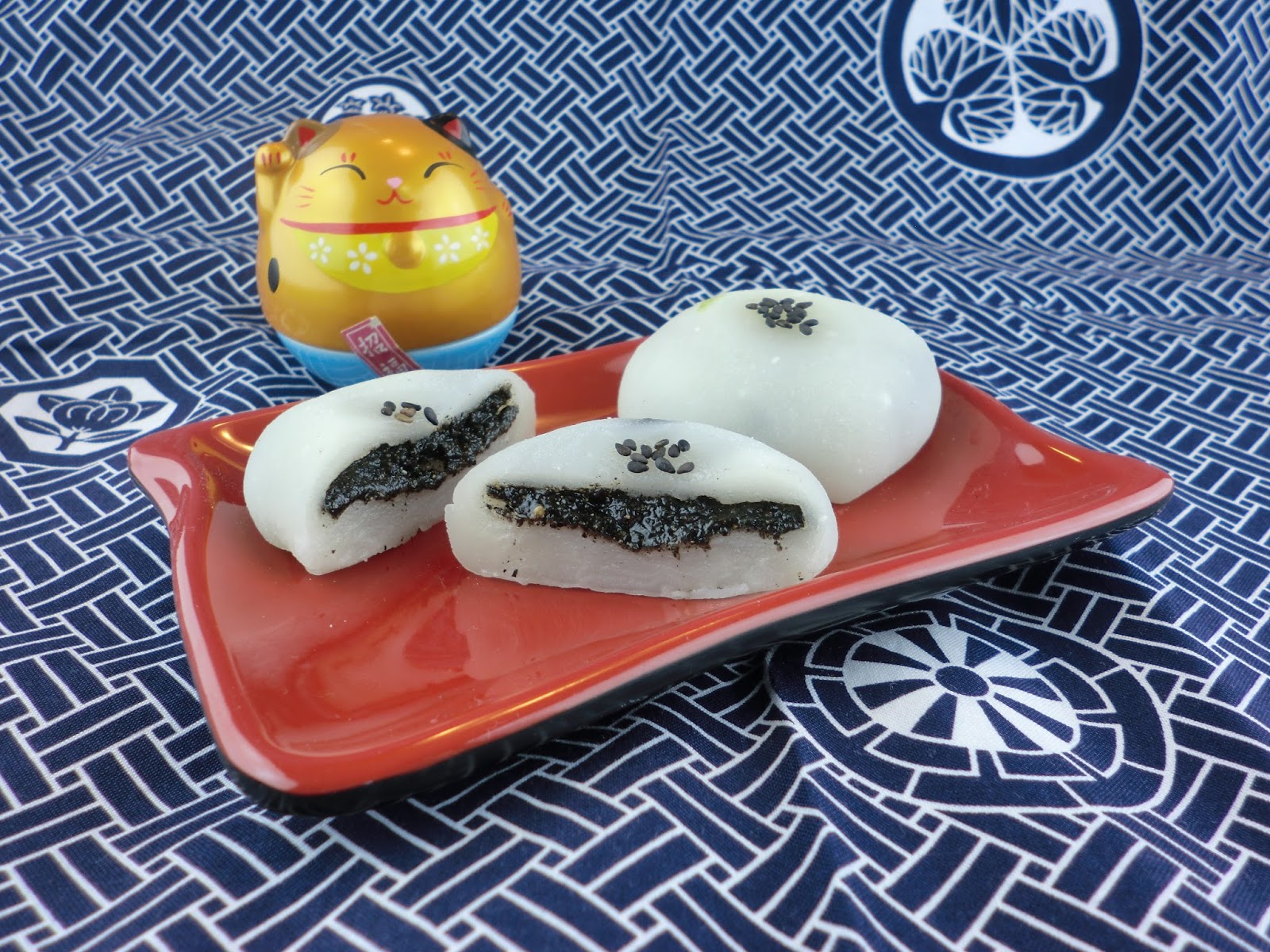
Strawberry Mochi & Black Sesame Mochi 苺大福と黒胡麻大福

Meow honestly don't make desserts "just because", I usually need a reason or an excuse.  Today's excuse was that Meow father wanted to try the mochi I made a few days earlier.  But being out of town, the mochi were a few days stale.  They're still good, but "not fresh".  What good daughter serves her father stale mochi anyway?  So, Meow made a fresh batch.  And since I'm making a fresh batch, I decided to throw in a couple of new fillings to try - black sesame and strawberry.


Reason for black sesame: Mr. Meow likes them.
Reason for strawberry: Meow has seen many blogs that have done this and concludes that it is popular (and Meow secretly likes/hoards strawberries)
Reason to make a new batch all together: the dough from the last batch was rather soft, barely stands on its own.  Need to play around with flour to water ratio to find sweet spot.

That's enough of an excuse I think...


Friday, August 23, 2013

Red Bean & Matcha Daifuku Mochi 小豆と抹茶大福餅

I have loved mochi since I was a little kid.  The flavour and texture always appeals to me.  However, I prefer the Japanese ones to the Taiwaneses/Chinese ones.  Not because I love everything that is Japanese (okay, yes), but because the Taiwanese ones are usually coated in dry shredded coconut or other gritty coverings; the Japanese ones are usually just dusted with starches.


I had been putting off of making mochi for quite some time, only because I know of a family friend who also makes this stuff and she claims that you have to basically work with a "boiling dough" in order for the mochi to stick back to itself, or something of the like.  Meow doesn't like burning her hand, see my incident on Not Nouget.  After reading a few recipes and blogs, mochi will still stick when it's warm, and to a certain extent, when cooled.  So, I have bean paste, I have mochi powder...trouble begins :D


Friday, August 16, 2013

Mizu-Youkan and Neri-Youkan 水羊羹と練り羊羹

Early on in my matcha bender, I gravitate towards youkan 羊羹 as my matcha treat, it is basically agar jelly.  Not exactly sure why, probably because of the hours I spent watching Ranma 1/2 and one of the characters was always serving youkan as a tea time treat.  I really didn't have much desire to make it but after I read the ingredients label of the bag that I bought, "red beans, water, sugar, agar", I said to myself, "forget this, I'm making it!".

While researching about youkan and its recipes.  I found out that there are two types of youkan, one is mizu-youkan 水羊羹, meaning "water youkan" made with more water; the other type is neri-youkan 練り羊羹, and if you guess that this one contains less water, you would be correct.

Basic mizu-youkan recipe typically calls for a 1:1 bean paste to water ratio, 2 grams of agar powder for every 100 mL of water, throw in enough sugar to your liking, which usually is not a lot since the bean paste is already sweetened, plus a pinch of salt (if you remember about it).  Simmer to melt everything down and pour into a mould to set.

Neri-youkan ratio can be anywhere from 2:1 or sometimes even 3:1 bean paste to water ratio, agar ratio is still the same as above 2 g per 100 mL, sugar to taste, and a pinch of salt.  Throw everything in to heat and dissolve, but this time, cook until it forms a ball mass, then press into a mould to set.


There is your recipe...in theory and in practice.  How often does that happen??

Friday, August 9, 2013

Shiro-an 白餡, White Bean Paste

Recently, I've finally figured out how to whip up a nice bowl of matcha.  One that is not bitter and vegetal.  But with matcha, I need some Japanese sweets to go with my tea as per tradition.  This gives me the opportunity to finally explore the world of wagashi, Japanese traditional sweets, which are usually served with green tea or during tea ceremonies.

Wagashi touches on the five senses.  It is pleasing to the eyes, to the tongue, to the nose, to the mouth, and to the ears as denoted by The Art of the Five Senses.  Wagashi often also uses natural ingredients to colour and flavour, usually corresponds with the seasons.  So, this provides a different level of challenge for Meow.

One of the challenges of making wagashi is finding the ingredients.  We are lucky enough in this city that it has an Asian supermarket that carries most of the starches that is required.  And also the ever increasing trend of vegan and gluten free diet has made such what the West considered "alternative flours" more readily available and in good quality.  I was able to find sweet rice flour (mochiko 糯粉), another type of sweet rice flour but processed differently (shiratama-ko 白玉粉), soy flour (kinako きな粉), even Japanese brand potato starch (katakuriko 片栗粉).  Other flours like arrowroot flour (kuzu-ko 葛粉), or potato starch, white/brown rice flour are available from the gluten-free aisle.  Raw, whole ingredients are somewhat easy to find, however, if I want to be lazy and buy pre-made fillings or pre-mixes, I'm out of luck.  The best this city can do is sell red bean paste in the form of koshi-an (smooth), or tsubu-an (coarse).  This is fine and all, however, wagashi doesn't stop at red bean paste fillings.  Other flavoured paste fillings require the basic white bean paste, shiro-an (白餡), and then be flavoured.  So, Meow's wagashi journey started off with the basics - making shiro-an.

The process uncannily resembles my mother's Sunday chore of making soy bean milk.